hmmIBDr
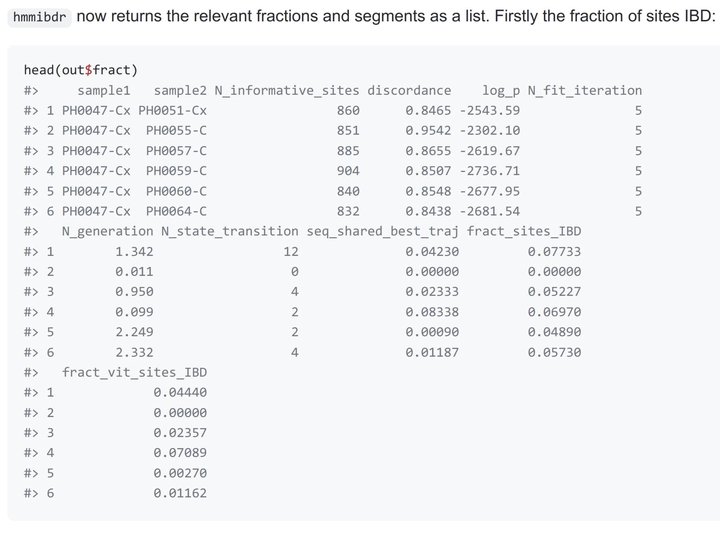
hmmibdr is an Rcpp wrapper for hmmIBD in Rcpp. There has been a recent proliferation in the number of malaria studies using IBD. As interest in IBD grows, the need to provide comprehensive details of software used to infer IBD increases. hmmIBD is the only program known to the authors that is designed specifically for haploid malaria genomes and is capable of comparing samples across populations with different allele frequencies. This will likely be a useful feature for malaria elimination efforts, since it could facilitate identification of imported malaria cases.
I claim no ownership over the original source code, and all attribution and acknowledgement should be referred to the original project, and the associated publication1. I have simply provided this wrapper in the hope that it might be helpful for others, and have provided a tutorial for basic use.
Schaffner, S.F., Taylor, A.R., Wong, W. et al. hmmIBD: software to infer pairwise identity by descent between haploid genotypes. Malar J 17, 196 (2018). (https://malariajournal.biomedcentral.com/articles/10.1186/s12936-018-2349-7) ↩︎

OJ Watson
Associate Professor
I’m an Associate Professor at Imperial College London, supported by an Eric and Wendy Schmidt AI in Science Fellowship. I’m based within Imperial’s AI Initiative, I-X, and the MRC Centre for Global Infectious Disease Analysis.
I develop open, reproducible methods at the intersection of infectious disease modelling, mortality estimation, and AI for public health — supporting decision-making and improving data equity. Recent applications include malaria and COVID-19.
Previously, I was a Schmidt Science Fellow at the London School of Hygiene and Tropical Medicine, and held postdoctoral positions at Brown University and Imperial College London.